
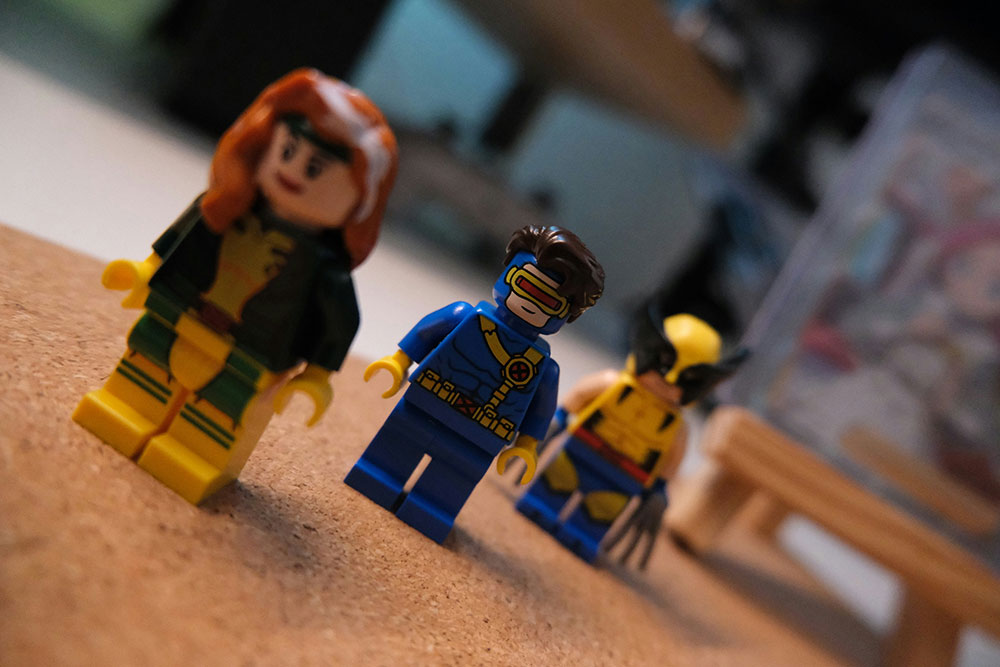
Legally, no. On January 3, 2003, the United States Court of International Trade ruled that Marvel's X-Men action figures do not represent human beings. Marvel's own toy subsidiary had asked for exactly that finding, because U.S. customs law taxed dolls representing humans at 12 percent and toys representing non-human creatures at 6.8 percent. The characters who spent decades fighting to be accepted as human were declared mutants by their own publisher, on the record, to lower the duty rate. The full story is a lesson in how one tariff heading can decide the margin of a product.
Why did they argue the X-Men are not human?
Because the tariff schedule made humanity expensive. In 1994, Toy Biz, the toy company that belonged to Marvel, imported action figures from China through the ports of Seattle and Los Angeles. U.S. Customs classified them under heading 9502 of the Harmonized Tariff Schedule, "Dolls representing only human beings", at 12 percent duty.
Toy Biz disagreed. Its lawyers, Sherry Singer and Indie Singh, argued that the figures belonged under heading 9503, "Toys representing animals or other non-human creatures (for example, robots and monsters)", at 6.8 percent. Their case rested on one word in the heading: only. A doll had to represent only a human being. Wolverine has claws that come out of his hands. Storm summons lightning. Not only human, the company said, and therefore not a doll.
The company sued in 1996. The court issued four opinions over the following years, in 2000, 2001, 2002 and 2003. The last one settled the question.
What is the HS code for action figures and dolls today?
HS-Code 9503. The distinction that carried the whole case disappeared at the international level with the 2007 revision of the Harmonized System, in force since January 1, 2007. That revision brought roughly 360 amendments and reduced the number of HS codes from 5,224 to 5,052 (WTO). Dolls, wheeled toys and other toys were merged into a single heading, and the heading text now reads "dolls' carriages; dolls; other toys".
Some countries kept the doll question alive one level down. The European Union's Combined Nomenclature still lists "dolls representing only human beings" as subheading 9503 00 21. In the United States, heading 9503.00.00 carries a general duty rate of free, and dolls are distinguished only for statistical purposes. The same product, declared in Hamburg or in Los Angeles, meets a different set of digits and a different set of questions.
If you want to see how a single HS code opens a product's entire trade flow, the silver code 7106 is a good companion read: Silver HS Code 7106 Explained.
What did the court decide in Toy Biz v. United States?
Judge Judith M. Barzilay sided with Toy Biz on almost every figure. The court's reasoning ran in three steps.
First, the wording of the heading had changed. The old U.S. tariff schedule simply said "dolls". The Harmonized Tariff Schedule, adopted in 1989, said "dolls representing only human beings". The court read that as a deliberate narrowing: a figure with even one non-human feature can no longer be a doll.
Second, the court looked at what the figures represent, not just what they resemble. Customs had argued that the figures have heads, eyes, arms, muscles and even gender, race and nationality, pointing to Professor X in his wheelchair, Bishop, Rogue and the Silver Samurai. The court answered that a figure can look like a person and still represent something else. The explanatory notes to the tariff already listed angels, devils, robots and monsters as non-human creatures, even where they look predominantly human.
Third, the court took popular culture seriously. Anyone familiar with Marvel Comics knows these characters as mutants, and the packaging itself called them "people born with 'x-tra' power". The court placed mutants in the same category as robots and monsters and classified the figures under subheading 9503.49.00 at 6.8 percent. Toy Biz was entitled to refunds on the duties it had paid.
The opinion runs through the figures one by one. The court's own word for the number was "dozens"; press accounts at the time counted more than 60.
Which characters were ruled non-human?
The X-Men and X-Force figures as a group, including Wolverine, Storm, Magneto, Cyclops, Longshot, Pyro and Rictor. The Fantastic Four series, including Mr. Fantastic with his stretchable arms, the Silver Surfer, Black Bolt and Terrax. Mole Man, whom the court called "truly a close call", ended up on the non-human side because of his troll-like features and subterranean story. Even Spider-Man's villains passed: Hobgoblin with his fangs, Dr. Octopus with his tentacles, Kraven with his exaggerated hunter's physique, and Kingpin, a man in a suit whose oversized body the court found freakish enough to be more than human.
Customs had conceded five figures before the ruling, among them Beast and a robot version of Wolverine. Five others were withdrawn from the case by agreement: Daredevil, the Invisible Woman, the Punisher, U.S. Agent and Peter Parker. The most human-looking figures never reached the judge.
One item lost. "Jumpsie", a doll with a battery-powered jumping mechanism and a toy trampoline, represented a girl and nothing else. Jumpsie stayed a doll at 12 percent.
Did they actually save money?
Yes, though only on the old shipments. By the time the final opinion appeared, the tariff had moved on. In a footnote the court noted that under the 2002 edition of the U.S. tariff schedule every toy heading, dolls included, carried a duty rate of zero. The ruling therefore had "retrospective practical effect only": refunds on the 1994 entries and on the other cases that had been suspended behind this test case.
That is a common pattern in classification disputes. The dispute takes years, the product line changes, the tariff changes, and the money at stake is the duty already paid on containers that cleared customs long ago.
What does the case teach importers about tariff classification?
Four things, and none of them is about superheroes.
One feature can change the heading. The court said that a single non-human characteristic removes a figure from the doll heading. The same logic applies to a pump with a built-in motor or a cable sold with its connector. The added feature is often what moves the product from one heading to another.
Both readings can be defensible. Customs and Toy Biz each had a coherent argument, and it took a court seven years to choose. Most companies never get that clarity. Their codes sit in the master data, assigned once, right or wrong.
Headings get revised. The battle line of this case vanished on January 1, 2007. The Harmonized System is amended roughly every five years, and each round merges or splits positions. A product list that was correct at the last revision may be out of date after the next.
Precedent from the old nomenclature does not carry over automatically. A 1989 court decision had held that G.I. Joe figures are dolls. Under the new wording, Wolverine was not. Same shelf in the toy store, two headings. Checking your own codes against the current nomenclature is cheaper than the refund case.
How can trade data show what your competitors declare?
The tariff schedule tells you what a heading says. Customs data tells you how the market actually uses it. Transaction-level trade data shows which companies import a product, under which HS code, from which suppliers and in which volumes. For a category like 9503, it shows whether competitors declare comparable products under the same subheading, which origins dominate and how flows shifted after a nomenclature change.
For sourcing and sales teams the practical question is rarely whether a heading exists. It is who is already shipping under it, and to whom. That is where the doll question stops being trivia and starts being a purchasing decision.
Take the opportunity ➜ Schedule a live demo!
Sources: Toy Biz, Inc. v. United States, 248 F. Supp. 2d 1234 (U.S. Court of International Trade, January 3, 2003, Judge Judith M. Barzilay); Wall Street Journal, "Fans Howl in Protest as Judge Decides X-Men Aren't Human", January 20, 2003; Harmonized Tariff Schedule of the United States, headings 9502 and 9503 (1994 and 2002 editions) and 9503.00.00; WTO Working Paper ERSD-2008-02 on the Harmonized System amendments of 2007; EU Combined Nomenclature, subheading 9503 00 21. Last updated: August 2026.


